PATENT-PENDING ARCHITECTURE
Four hardware pillars engineered to eliminate OS-level audio interception vectors.
End-to-End. Edge to Edge.
End-to-end voice
Edge to edge. The server is blind.
Speaker A
Earbud · Secure element
AES-GCM 256
ML-KEM-1024
BCrypto Relay
Sees opaque traffic
AES-GCM 256
ML-KEM-1024
Speaker B
Earbud · Secure element
Encrypted in the earbud
Not in the phone. Not in the server.
Relay forwards only
BCrypto cannot decrypt the traffic it carries.
Hybrid post-quantum
ML-KEM-1024 + AES-GCM 256.
Keys are negotiated and unwrapped inside the earbuds' secure element. The phone, the network and the BCrypto relay only ever see opaque ciphertext.
Direct or relayed. Always blind.
See how the network mode is chosen automatically — and why the relay cannot read what it forwards. Deep dive
Network Architecture
P2P direct or server relay. Either way, the server is blind.
Mode A
P2P Direct
Caller
Peer
When NAT allows it. Lowest latency, lowest cost.
Mode B
Relay Mode
Caller
Peer
When networks block P2P. Relay forwards ciphertext only.
Server never holds keys
Endpoints derive the session secret
ML-KEM-1024 + AES-GCM
Same crypto in both modes
Auto-select
Tries P2P first, falls back gracefully
The relay is a passive packet forwarder. It cannot read, modify, or replay the ciphertext stream — even under coercion.
Core Technological Pillars
HARDWARE-BOUND AUDIO PATH
The DMA controller transfers raw audio from microphones directly to Secure SRAM via isolated bus. After Secure Boot, DMA registers are write-locked — no malware, even at kernel Ring 0, can access plaintext audio data or reconfigure the driver path. This creates a physical trust boundary that is mathematically independent of the host device's security state.
ON-DEVICE ANTI-DEEPFAKE ENGINE
A TEE-resident analysis engine computes a real-time Confidence Index C using LFCC spectral analysis (detecting neural vocoder artifacts above 8kHz), respiratory coherence (liveness detection), and voiceprint matching. By executing these neural models entirely within the local secure enclave, Q-AUDION ensures zero-latency detection without exposing sensitive voice data to third-party cloud services.
ADAPTIVE SOVEREIGN CRYPTOGRAPHY
Session keys combine ML-KEM-1024 (NIST post-quantum standard) with a hardware-resident Pre-Shared Key (PSK) injected exclusively via a dedicated physical interface by the operator. Key duration T is a dynamic function of Confidence Index C: when even slight acoustic anomaly is detected, the system automatically triggers an immediate re-generation sequence via the sovereign PSK path. The entire Liveness Analysis → Vocoder → Encryption stack operates within a deterministic latency budget of under 200ms end-to-end, meeting the isochronous requirements of real-time tactical voice communications.
TRAFFIC ANALYSIS RESISTANCE
Unlike VBR-based encrypted VoIP which leaks metadata through packet size analysis, Q-AUDION enforces a strict, hardware-timed Constant Bitrate (CBR) stream. The cryptographically secure adaptive padding ensures that every packet is identical in size and timing, rendering traffic fingerprinting attacks computationally prohibitive for even state-level actors.
ALWAYS-ON PROTECTION: ACTIVE IN EVERY CALL
The anti-deepfake engine and Confidence Index C analysis do not require the call to be encrypted to operate. The classifier runs on-device — on the phone today, moving to the earbud's TEE as that hardware ships — analyzing the audio path separately from the encryption path, regardless of whether the output stream is encrypted with ML-KEM-1024 or transmitted in the clear through any VoIP platform, messaging app, or traditional telephone network. The engine calculates the Confidence Index C every 20 ms, detects neural vocoder artifacts above 8 kHz, assesses respiratory coherence, and compares voiceprints. The user receives a discreet real-time alert in case of an anomaly. No audio data leaves the device. No remote server is involved. No calling platform needs to be replaced or modified.
Architecture
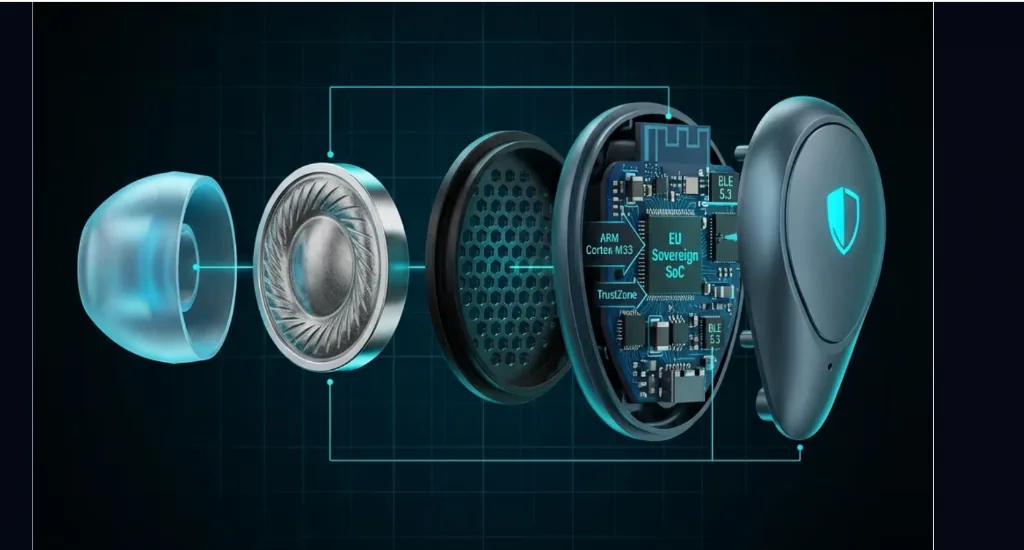
SECURE BOOT SEQUENCE
HARDWARE ROOT OF TRUST
The secure bootloader verifies the digital signature of the RTOS kernel against keys fused in hardware OTP memory during manufacturing.
DMA REGISTER LOCKING
Post-initialization, the memory management unit locks the DMA steering registers. Audio paths are physically isolated from non-secure Cortex cores.
TEE ENVIRONMENT BOOT
The Trusted Execution Environment initializes with encrypted SRAM allocation, isolating anti-deepfake analysis and crypto operations.
PQC+PSK HANDSHAKE
Adaptive session keys are derived using ML-KEM-1024 and hardware pre-shared keys to establish the sovereign uplink.
TECHNICAL FAQ
How does Q-AUDION prevent pre-encryption audio capture?
Unlike standard Bluetooth headsets where the mobile OS handles the audio driver, Q-AUDION routes microphone signals directly to an internal Secure SRAM via an isolated I2S bus. The host device only receives an encrypted CBR stream. Even if the smartphone kernel is compromised by zero-click spyware like Pegasus, there is no physical path to the raw, unencrypted acoustic data.
What makes ML-KEM resistant to quantum attacks?
ML-KEM (Kyber) relies on the Module Learning with Errors (M-LWE) lattice problem, which is conjectured to be secure against both classical and quantum algorithms. Unlike RSA and ECC, which Shor's algorithm can break, M-LWE remains mathematically unfeasible for cryptographically relevant quantum computers (CRQC), ensuring long-term data sovereignty.
What is the Confidence Index C?
The Confidence Index C is a dynamic metric computed every 20ms by the internal NPU. It aggregates LFCC spectral analysis, respiratory coherence, and voiceprint entropy. If C falls below a sovereign-defined threshold—indicating suspected injection or AI manipulation—the system triggers 'Adaptive Re-keying', rotating session keys via the hardware PSK path instantly.
How does on-device deepfake detection work without cloud?
Q-AUDION features a low-power NPU optimized for TinyML neural network inference. It uses a proprietary model trained to detect synthetic vocoder artifacts and acoustic discontinuities characteristic of AI voice conversion — including voices generated by systems such as ElevenLabs, RVC, and voice transformer architectures. Execution occurs entirely within the local TEE, eliminating latency and man-in-the-middle risks of cloud-based AI services. The engine is active in every call, regardless of whether the session is encrypted or not: the DMA → TEE path is architecturally separated from the cryptographic module. This means anti-deepfake protection works on any platform — Teams, Zoom, WhatsApp, traditional telephony — without the user having to do anything and without any audio data ever leaving the secure chip.
Why does sovereign key injection matter?
The Sovereign Edition allows for manual 'Sovereign Key Injection' via an air-gapped physical interface. Government agencies can inject their own master PSK directly into the device's secure enclave. This ensures that the communication remains encrypted with a key physically possessed only by the sovereign entity, not the manufacturer or any third party.
How does Constant Bit Rate (CBR) prevent traffic analysis?
Standard encrypted VoIP uses Variable Bit Rate (VBR), leaking information through packet timing and size. Q-AUDION enforces a strict, hardware-timed CBR stream with adaptive padding. Every packet is identical in size and timing, rendering traffic analysis and 'fingerprinting' attacks by sophisticated adversaries computationally prohibitive.
How is the hardware root of trust established?
At power-on, an immutable ROM-based bootloader verifies the TEE firmware signature. Once verified, the hardware 'locks' the DMA registers, preventing any software—even a malicious host OS with root privileges—from reconfiguring audio paths or accessing secure memory regions where keys reside. This creates a state-persistent hardware trust boundary.
Is the Sovereign Edition TEMPEST hardened?
The Sovereign Edition is designed with multi-layer TEMPEST-ready PCB shielding and RF decoupling filters. This architecture is targeted at mitigating compromising emanations risk in SCIF and similar high-security environments. Independent TEMPEST evaluation is a stated roadmap item.
DOES Q-AUDION USE VOICE BIOMETRICS TO UNLOCK THE DEVICE?
No. Voice biometrics were evaluated for the GEN-1 hardware and deliberately excluded: template extraction and replay with synthetic audio give an attacker a bigger attack surface than the convenience is worth. Device and session protection instead rely on the hardware root of trust described above — Secure Boot, DMA-locked audio paths, and the ML-KEM-1024 PQC handshake — not on a biometric voiceprint gate.
DOES DEEPFAKE DETECTION WORK IN UNENCRYPTED CALLS?
Yes. The analysis engine resides in the hardware TEE and receives raw audio from the DMA controller before the stream is routed to any codec or network stack. This path is architecturally independent of the ML-KEM+PSK cryptographic module. When encryption is not active — for example, during a normal GSM/VoIP phone call or a video conference on Teams, Zoom, or WebEx — the TEE continues to analyze the signal and calculate the Confidence Index C. The user receives the anomaly alert exactly as in encrypted mode. In no case is raw audio transmitted outside the device or sent to cloud services.
TECHNICAL SPECIFICATIONS
| SPECIFICATION | TARGET VALUE |
|---|---|
| End-to-end latency target | < 200ms |
| Audio path latency | < 10ms (deterministic) |
| Confidence Index C refresh rate | 20ms (50Hz) |
| Key duration range (T) | 5s – 60s (adaptive) |
| Encryption | AES-256-GCM (constant-time implementation) |
| Key exchange | ML-KEM-1024 + HKDF with cryptographic nonces |
| Padding | CBR adaptive (C-driven complexity) |
Specifications represent target architecture per patent filing IT 2026.
READY FOR A TACTICAL BRIEFING?
Detailed protocol specifications and sovereign implementation guides are available for authorized government and defense agencies.
REQUEST FULL TECHNICAL DOSSIER