Encrypted calls. Verified voices.
Q-AUDION protects communications for banks, insurers and energy companies: end-to-end post-quantum encryption, on-device voice deepfake detection and an installation under your control.
Download on the App Store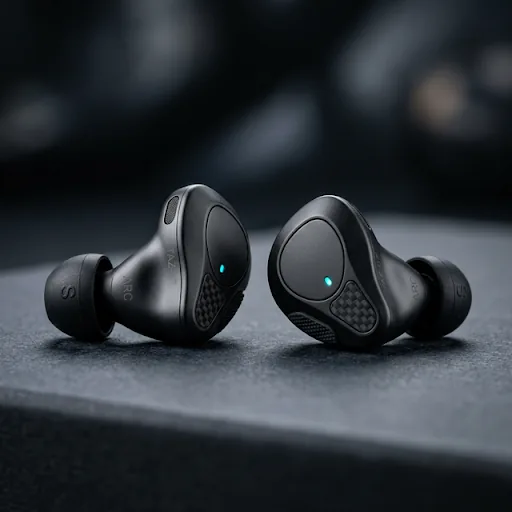
Q-AUDION is on the App Store
The iPhone app is available from 22 October 2026: calls, video and chat encrypted end to end with post-quantum cryptography.
On Android, Google Play is coming soon.
For banks, insurers and energy
Where a conversation authorizes money, claims or work on the grid, the identity of the speaker and the confidentiality of what is said matter more than speed.
Banks
A cloned voice of a senior executive asks for an urgent payment. The person answering sees whether the contact is verified, and is alerted during the call if the voice shows signs of synthesis, before acting.
See howInsurance
Loss adjusters, lawyers and reinsurers share expert reports and health data. The content stays readable only to the participants, even in a crisis room with many people.
See howEnergy
Control rooms, on-call duty and incident management need a channel that holds up on difficult networks and a hash-chained audit log, useful for the NIS2 early warning and notification deadlines.
See howPatent filed at UIBM, 2026
DMA Air-Gap. Your phone never hears you.
Microphone
MEMS I2S
Secure Enclave
TEE · TrustZone-M
ML-KEM-1024 · AES-256-GCM
Host phone
OS, apps, spyware
Plaintext audio
Only inside the secure enclave
Ciphertext only
What the phone sees: encrypted bytes
Blocked at hardware
Host OS cannot reach the microphone
Even with spyware on the host phone, the audio path is physically isolated by the DMA descriptor lock at boot time. The plaintext never enters memory the host OS can address.
Post-quantum channel
A tunnel built to resist quantum computers.
ML-KEM-1024 + X25519 · NIST FIPS 203
Endpoint A
Sovereign Silicon
Endpoint B
Sovereign Silicon
Hybrid PQC handshake
Protects today's traffic against tomorrow's quantum computers.
Harvest-now, decrypt-later — neutralized
Captured ciphertext stays opaque even after Q-Day.
Sovereign endpoints
Keys are held only by the endpoints, with no third party in the path.
The tunnel is terminated only by sovereign silicon at both ends. Keys are negotiated with NIST-standardized post-quantum primitives and bound to hardware identities — nothing in the middle can read it, today or after Q-Day.
Hardware anchor of trust
Both the app and the earbud keep their keys in hardware. Only the earbud isolates the microphone itself.
Q-Audion Earbud
Secure Element + PQC engine
MEMS mic
hardware-bound
Secure Element
tamper-resistant
Per-call keys
ephemeral
Anti-tamper
boot-locked
Host phone
hardware-backed keys, ciphertext only
Compromised OS does not affect security. It only sees ciphertext.
↕ BLE · ciphertext only ↕
Trust anchor lives in the earbud
Not the phone. Not the cloud.
Your phone can be malware-ridden
The earbud doesn't care.
Hardware-bound keys
Never extractable. Never on the phone.
The app
Six screens. One coherent stack.
The Android, iOS and Windows apps share the same protocols and security logic. These are real screens of the Q-AUDION app.
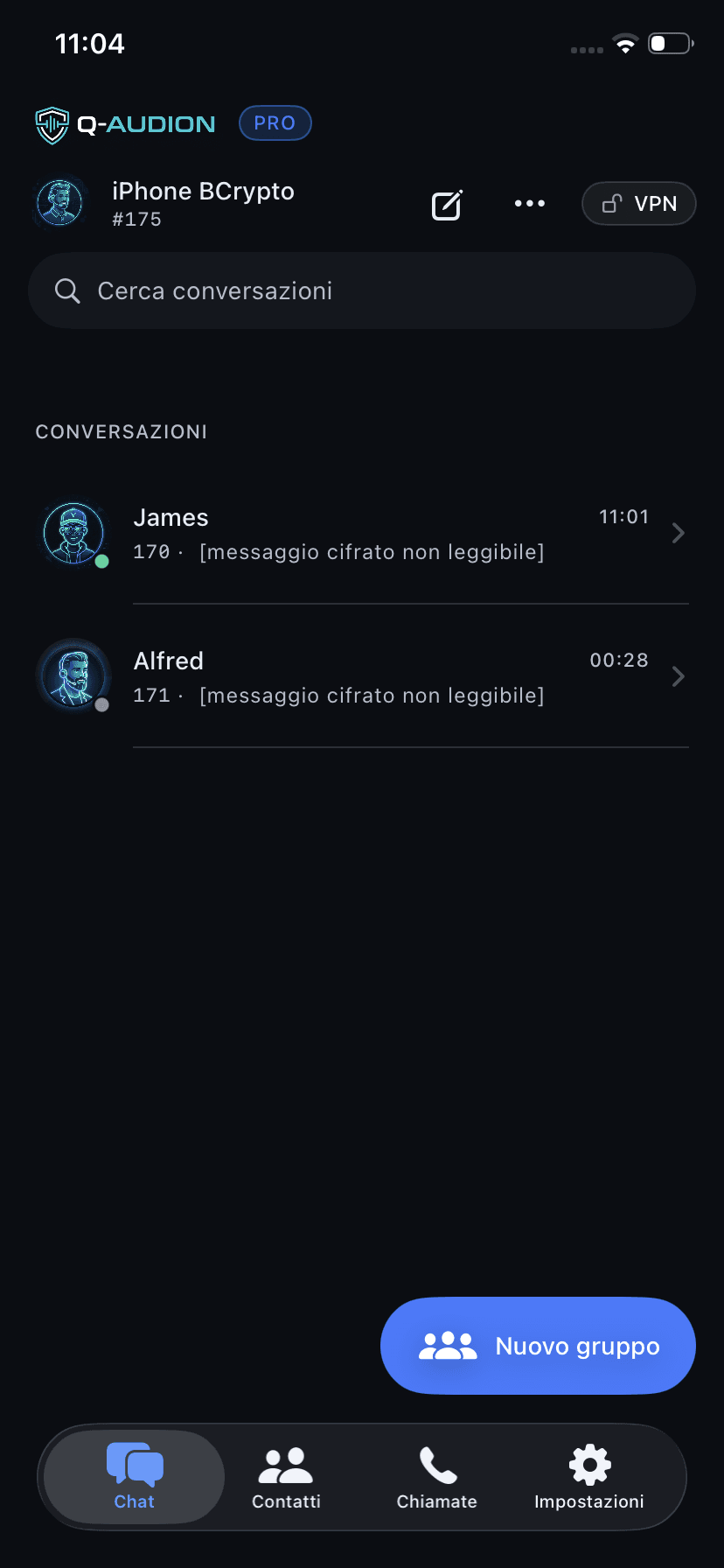
Encrypted conversations
Channel list with re-keying status, synced devices, new-device compromise badge.
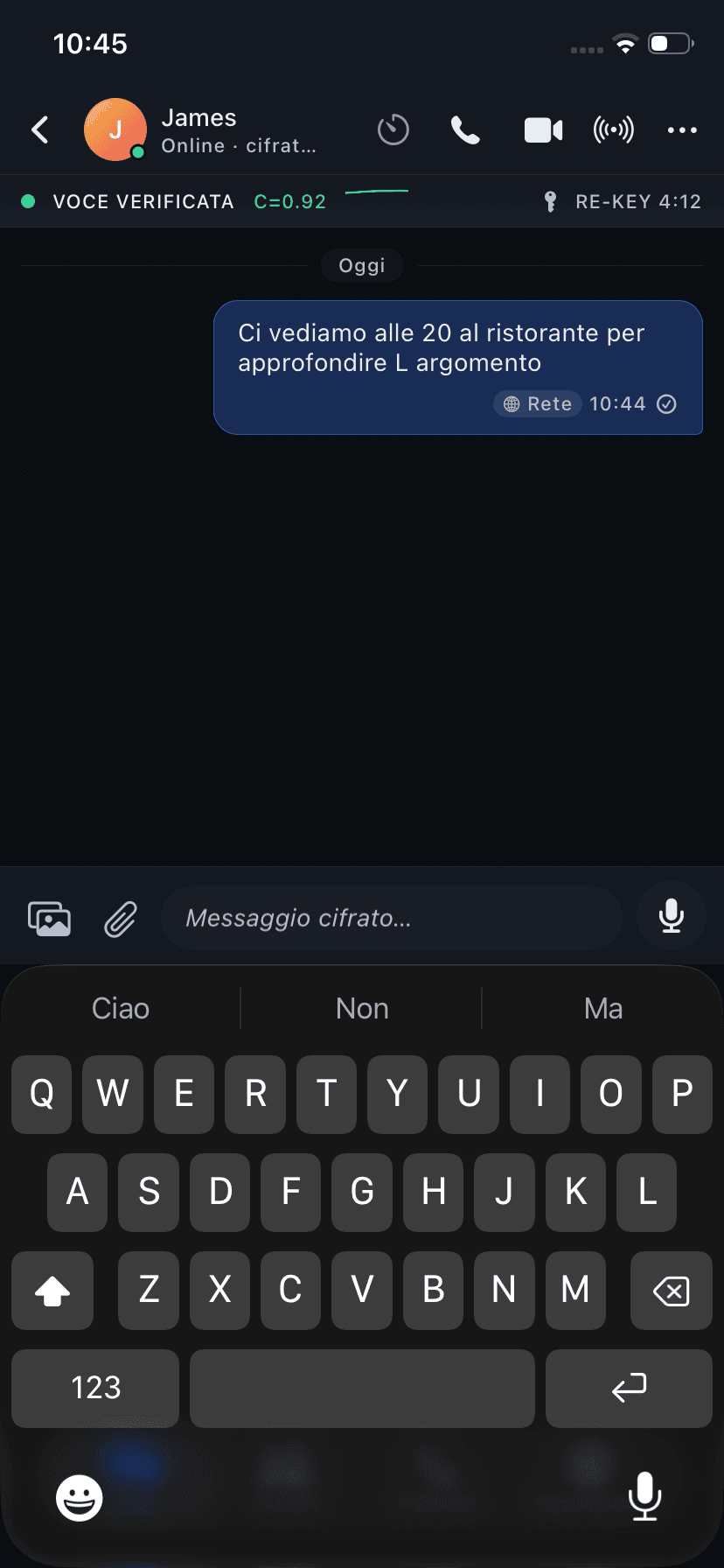
Voice verified
Verified voice badge inline in the conversation, re-key countdown visible.
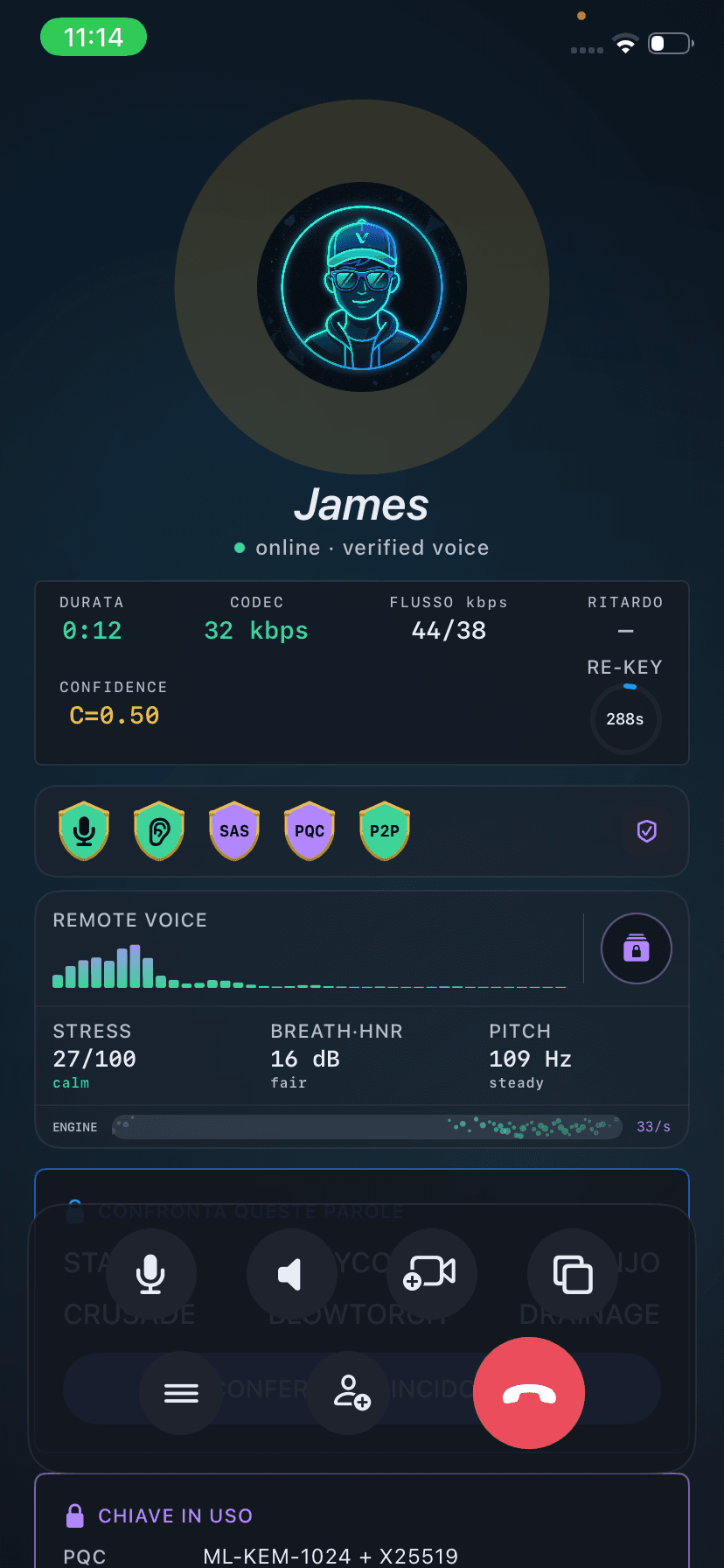
Encrypted call in progress
Verified voice, session duration, key renewed with a new ML-KEM-1024 + X25519 handshake at most every 5 minutes.
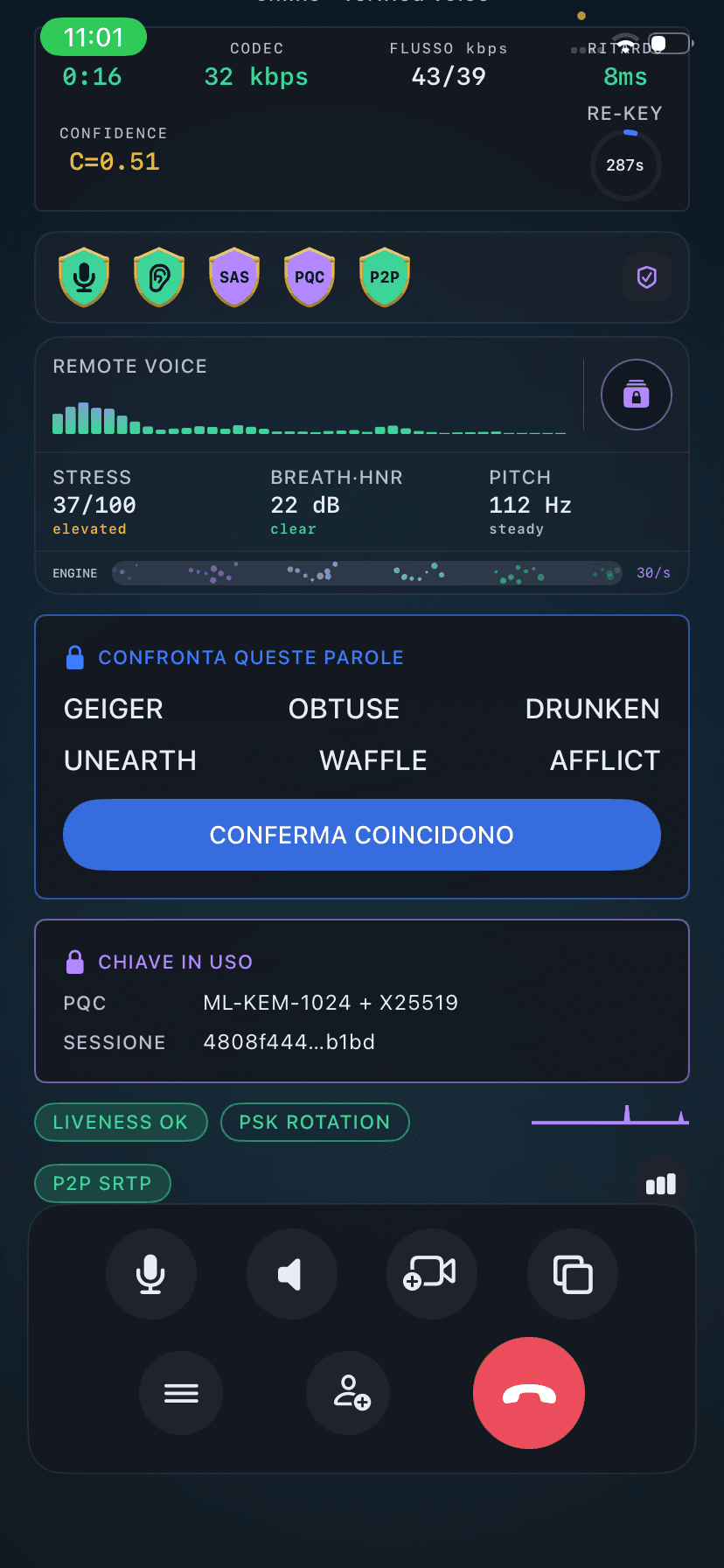
Guardian Live anti-deepfake
Real-time confidence from the on-device engine. Pitch jitter, spectral coherence, anomaly timeline.
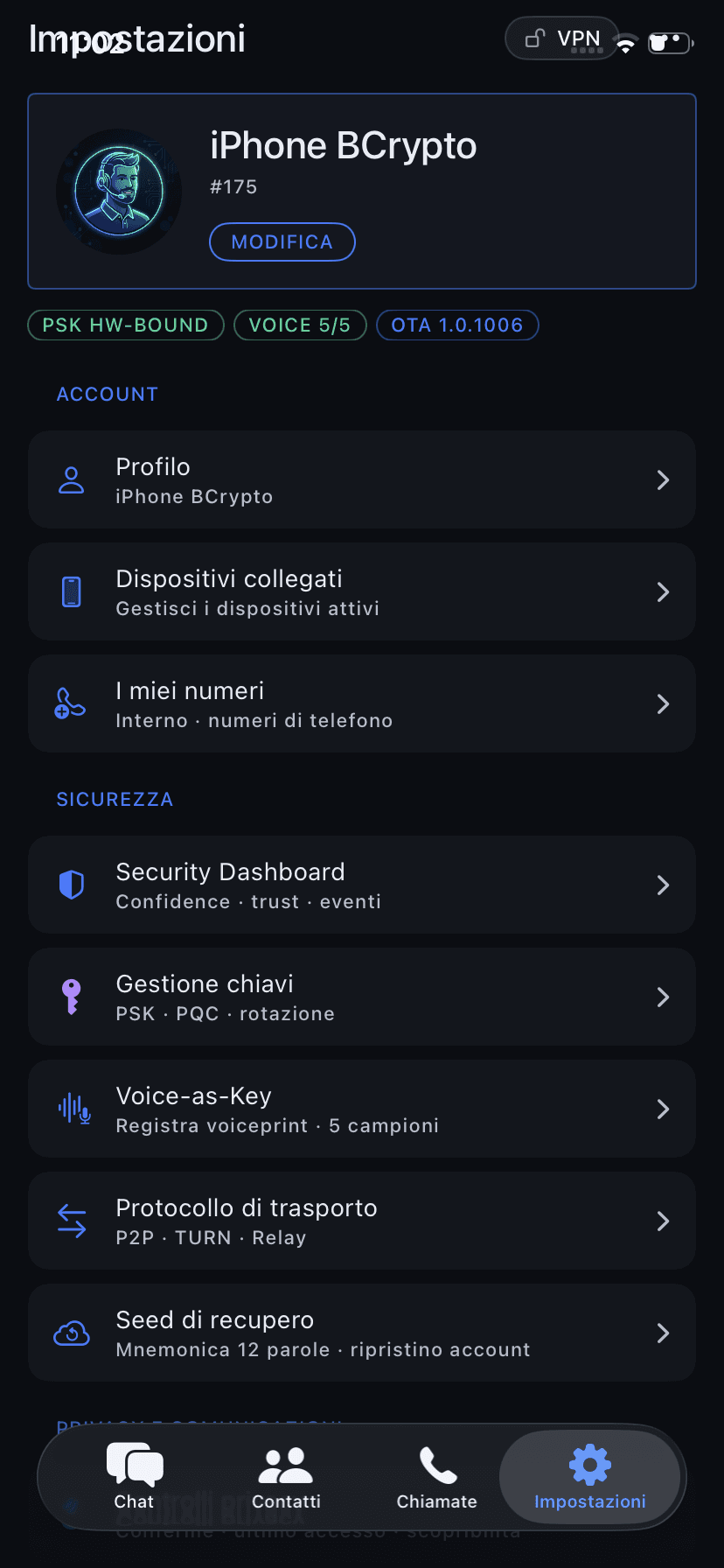
Key Management
PSK rotation and PQC key state, visible and under your control.
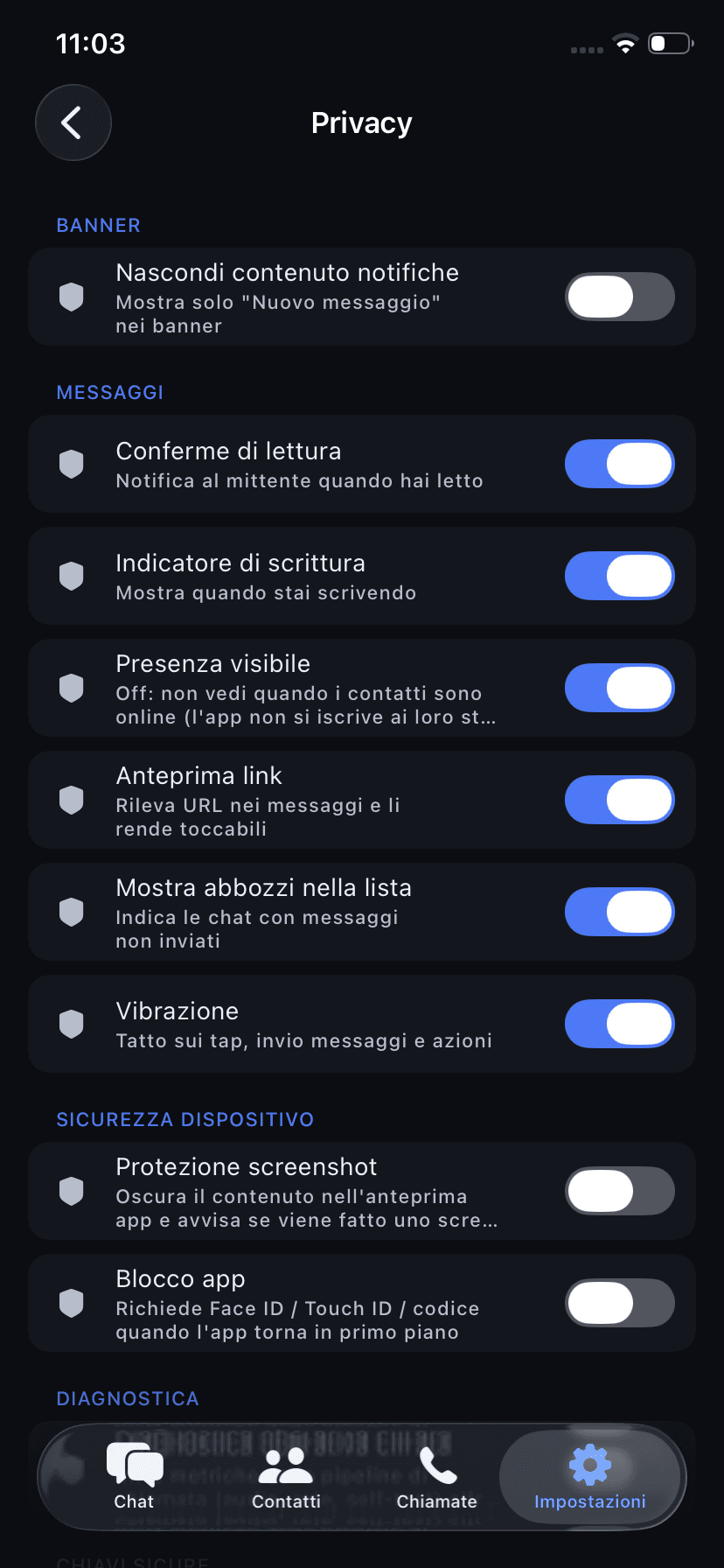
Granular Privacy
Screenshot protection, app lock, per-feature toggles.
Android integrations
On your wrist, in your car, in your ears.
Integrations with Wear OS, Android Auto and Galaxy Buds: encrypted calling that follows you beyond the handset.
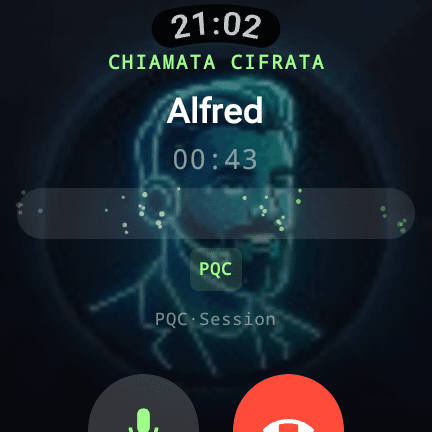
Live call status on your wrist
A companion app mirrors the active call on a Wear OS watch: contact, duration, mute state and the post-quantum session badge.
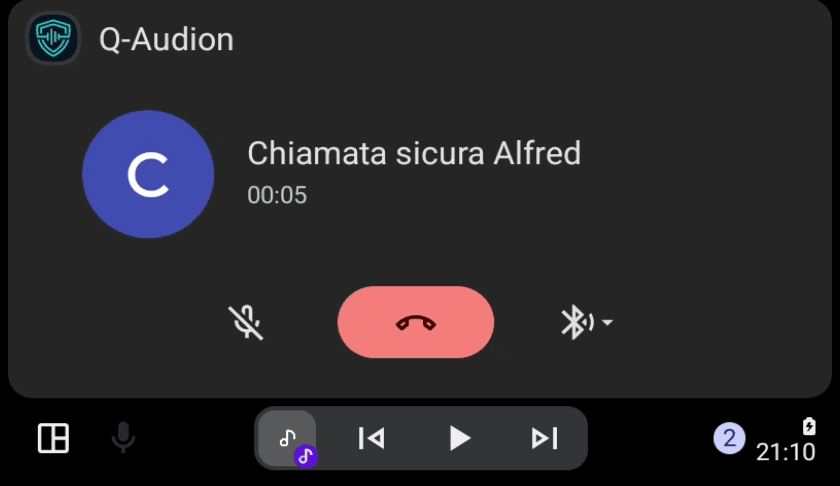
Encrypted calling, natively on the head unit
Q-AUDION includes an Android Auto integration for the car display: messages and the active call, shown natively on the head unit and not mirrored from the phone.
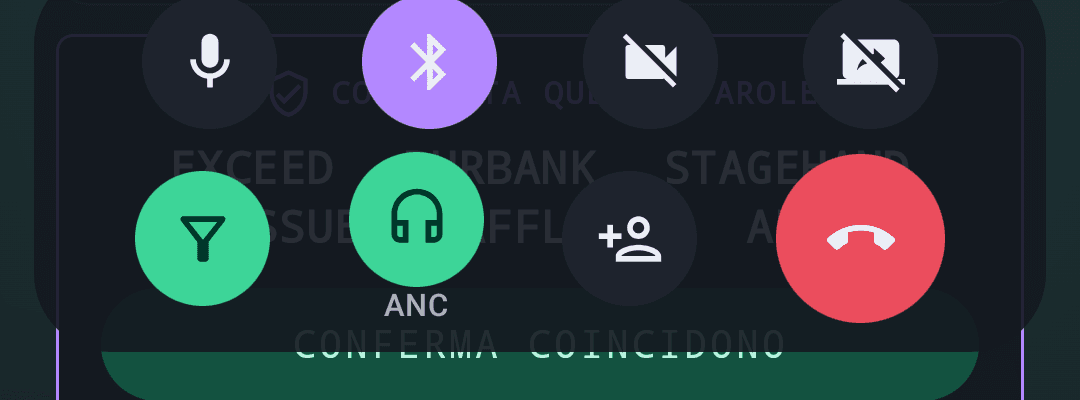
Active noise cancellation, tied to the call
When Galaxy Buds are connected, Q-AUDION switches ANC on automatically as the call starts and off when it ends, with a one-tap toggle in the call screen — controlled from the phone app.
Engineering dispatch
Stay close to the technical work.
One email a month. Only real product and engineering updates. No marketing.
Double opt-in. One-click unsubscribe. No profiling.
In 1906, the Audion invented by Lee de Forest amplified the human voice for the first time through a physical component. One hundred and twenty years later, Q-AUDION completes the inverse journey: it encrypts and verifies the voice, with post-quantum cryptography and on-device deepfake detection.
The voice becomes a sovereign domain once again.
The phone is the weak point
Commercial zero-click spyware reads what is said before it is encrypted. How it works is documented by independent researchers and by operating system vendors.
Pegasus
Commercial zero-click spyware
- Exploits operating system vulnerabilities without any action by the user
- Reaches the microphone, camera and location
- Documented by Citizen Lab and Amnesty International
Predator
Commercial spyware offered as a service
- Captures audio before encryption
- Documented by Google's Threat Analysis Group
- The subject of a European Parliament inquiry
Candiru
Zero-day vulnerabilities on Windows and mobile devices
- Exploits browser zero-day vulnerabilities
- Documented by Microsoft and Citizen Lab
- Aimed at activists, lawyers and journalists
Threat model
Risk assessment for CISOs and procurement
Commercial spyware
Spyware such as Pegasus and Predator compromises the phone's operating system and can capture the microphone before encryption. With the Q-AUDION earbud, the microphone signal goes through an isolated hardware area that the phone's operating system cannot access.
Operating system rootkits (Ring 0)
A kernel-level rootkit gives an attacker control of the phone's drivers and memory, the same environment where encryption software runs. On the Q-AUDION earbud, the DMA registers are locked by the hardware during Secure Boot and separate voice processing from the phone's kernel.
AI voice deepfakes
AI voice cloning can reproduce an executive's voice and lead to unauthorized payments or access. Q-AUDION assesses the other party's voice in real time with an on-device anti-deepfake model (AASIST) and alerts during the call. Audio is not sent to the server for this analysis.
HNDL quantum attacks
Encrypted traffic can be collected today to be decrypted once quantum computers are available (Harvest Now, Decrypt Later). Q-AUDION protects every call with the hybrid ML-KEM-1024 + X25519 key exchange, based on the NIST FIPS 203 standard.
Internal architecture of the earbud
Hardware isolation of the audio path
Dual processor
Cortex-M33 and a dedicated NPU for anti-deepfake analysis and for computation in the secure area.
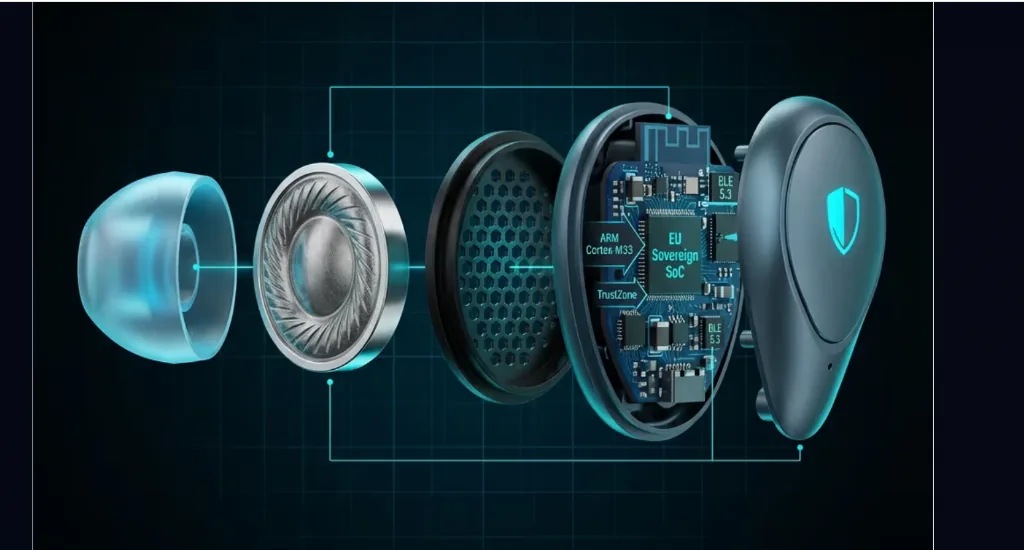
Anti-tamper resin
Multi-layered opaque epoxy resin that protects the components from physical analysis.
Architecture protected by three patents filed at the UIBM in 2026.
How it Works
End-to-end voice
Edge to edge. The server sees only ciphertext.
Speaker A
Earbud · Secure element
AES-GCM 256
ML-KEM-1024
BCrypto Relay
Sees opaque traffic
AES-GCM 256
ML-KEM-1024
Speaker B
Earbud · Secure element
Encrypted in the earbud
Not in the phone. Not in the server.
Relay forwards only
BCrypto cannot decrypt the traffic it carries.
Hybrid post-quantum
ML-KEM-1024 + AES-GCM 256.
Keys are negotiated and unwrapped inside the earbuds' secure element. The phone, the network and the BCrypto relay only ever see opaque ciphertext.
The contact is verified
NFC pairing with an Ed25519 signature and a 6-digit SAS, a proximity QR code or a 60-digit safety number confirm who is on the other end.
The call starts encrypted
An ML-KEM-1024 + X25519 handshake creates a new key for every call. Voice, video, messages and files are end-to-end encrypted with AES-256-GCM.
The voice is assessed in real time
An on-device anti-deepfake model (AASIST) analyzes the other party's voice and alerts without interrupting the call. Audio is not sent to the server for this analysis.
The key is renewed
During the call the key is renewed with a new ML-KEM-1024 + X25519 handshake at most every 5 minutes, and more often if the voice shows signs of synthesis.
Voice deepfake detection
A model on the device, selected according to the phone tier, assesses the other party's voice in real time and alerts without interrupting the call.
Alert during the call
The person answering sees whether the contact is verified and receives an alert if the voice shows signs of synthesis, before acting.
Analysis on the device
The AASIST model runs on the phone; with the Q-AUDION earbud the analysis runs on the earbud's NPU. Audio is not sent to the server for this analysis.
Key renewed more often
If the voice shows signs of synthesis, the call key is renewed more often with a new ML-KEM-1024 + X25519 handshake.
Detection is a decision-support tool based on statistical analysis. Audio is not sent to the server for this analysis.
Five functions, one system
Encryption, identity verification and voice analysis work together, on phone and earbud.
Isolated audio path
With the Q-AUDION earbud, the microphone is not connected to the phone's operating system: the audio signal goes through an isolated hardware area before it is encrypted.
On-device deepfake detection
An anti-deepfake model (AASIST) assesses the voice in real time and alerts without interrupting the call. On the earbud, the analysis runs on the NPU. Audio is not sent to the server for this analysis.
Adaptive key renewal
A new key for every call, renewed with a new ML-KEM-1024 + X25519 handshake at most every 5 minutes and more often if the voice shows signs of synthesis.
Root key at your site
With the server installed at the customer's site, the root key stays in the customer's infrastructure.
Contact verification
NFC pairing with an Ed25519 signature and a 6-digit SAS, proximity QR codes and a 60-digit safety number.
Three patents filed at the UIBM in 2026 (nos. 102026000004873, 102026000010795, 102026000011575) protect the architecture.
One post-quantum system, four components.
Q-AUDION is not just an earbud: apps, server and earbud share the same protocols.
Hardware
Q-AUDION earbud
Encrypted earbud with an audio path isolated from the phone's operating system. ML-KEM-1024 encryption and anti-deepfake analysis on the earbud's NPU.
Mobile and desktop
Q-AUDION apps
Android, iOS and Windows, with the same protocols on every client and ML-KEM implementations verified with deterministic test vectors.
Infrastructure
Q-AUDION server
Signaling, relay and media that route only ciphertext. In a dedicated EU cloud or installed at the customer's site.
Network
Q-AUDION PQC VPN
VPN with a hybrid post-quantum key exchange: ML-KEM combined with classical encryption.
Government, defense and enterprise
Defense and special forces
Field operations. End-to-end encrypted calls and messages, with the Q-AUDION earbud isolating the audio path from the phone.
Learn moreGovernment and diplomacy
Embassy networks and ministerial communications. A server that can be installed at the agency's site, with the root key in its own infrastructure.
Learn moreIntelligence services
End-to-end encrypted channels, with contact verification through NFC, QR code or safety number.
Learn moreEnterprise security
Protection of senior executives against industrial espionage and AI-driven social engineering, with voice deepfake detection during the call.
Learn moreBusiness and professional
Executives, lawyers and consultants handling high-value negotiations: end-to-end encrypted calls, messages and files.
Learn moreTry Q-AUDION with your team
We invite banks, insurers and energy companies to try Q-AUDION. Leave your details: we will get in touch within two business days to activate your access.
Enterprise Brief
Four pages on what Q-AUDION does, how it is installed and how to try it. For banks, insurers and energy companies.